The pictures in our articles might not always show exactly what the text is talking about. We use these images to make the article more interesting and eye-catching. They are there to add to the text, but not to replace it or show every detail.
Spam is one of those foods that lives at the intersection of nostalgia, convenience, and mild guilt. The blue can, the pink brick, the suspicious gelatin layer — it's been on shelves since 1937, survived a world war, conquered Hawaii, and somehow turned into a meme. But the same can that built a global fanbase also built a reputation: tasty, cheap, shelf-stable — and very, very salty.
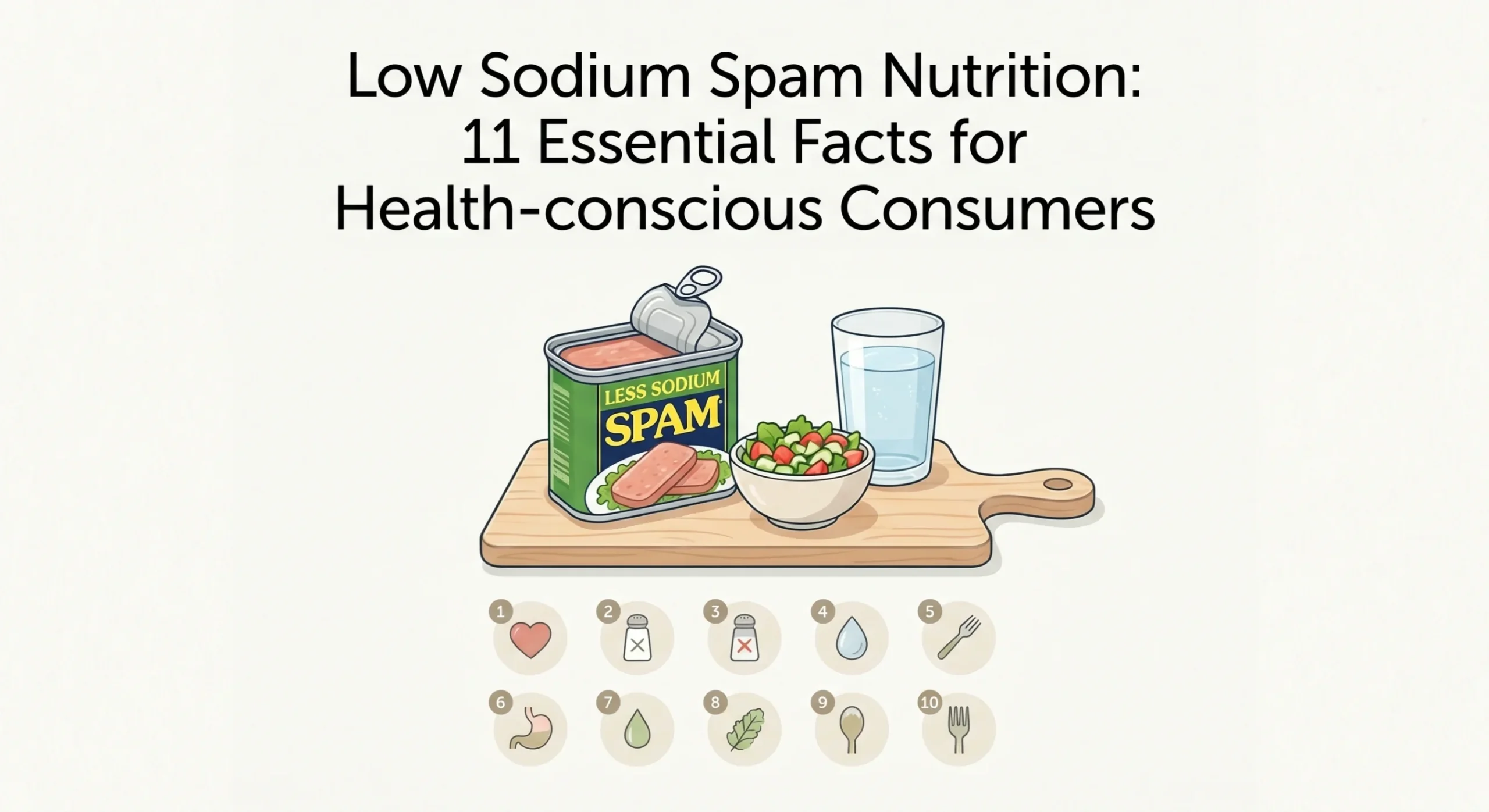
That last part is where the "Less Sodium" version comes in. Hormel sells a 25%-reduced-sodium Spam (sometimes labeled SPAM® Less Sodium, sometimes "25% Less Sodium Classic"), and it gets pitched as the heart-friendly cousin of the original. The pitch is half true. The numbers tell a more interesting story than most blog posts let on — including the original article this one is rewritten from, which got several of the basic facts wrong.
Let's go through what's actually on the label, what the math means in the context of a real daily diet, and where the marketing oversells.
The actual nutrition numbers (per 2 oz / 56 g serving)
This is one serving — roughly a third of the can. Here's what you're actually getting:
- 180 calories
- 16 g of fat, of which 6 g saturated
- 40 mg cholesterol
- 570 mg sodium
- 1 g carbohydrate (1 g sugar, including 1 g added sugar)
- 7 g protein
- 200 mg potassium
That sodium number — 570 mg — is the headline. Classic Spam clocks in at around 790 mg per serving, so the "25% less" claim checks out arithmetically. It's a real reduction, not a marketing rounding trick.
But notice what didn't change: the fat is identical (16 g), the calories are identical (180), the saturated fat is identical (6 g). The original article this piece is based on claimed low-sodium Spam has "6 grams of fat per serving" and "9 grams of protein." Both are wrong. The fat is nearly three times that, and the protein is slightly lower than advertised. This matters, because the version of "healthier Spam" floating around the internet is partly fiction.
What 570 mg of sodium actually means
A number on a label only tells you something if you can place it on a scale. Here's the scale:
The 2020–2025 Dietary Guidelines for Americans recommend that adults cap sodium at 2,300 mg per day — roughly one teaspoon of salt. The American Heart Association sets the same upper limit but suggests an ideal target of 1,500 mg per day, especially for adults with high blood pressure, which is most adults over 50.
So a single 2 oz serving of less-sodium Spam delivers:
- About 25% of the 2,300 mg ceiling
- About 38% of the 1,500 mg ideal limit
For comparison, Classic Spam at 790 mg eats up 34% of the ceiling or 53% of the ideal target in one serving. So yes, the lower-sodium version meaningfully helps — but calling it "low sodium" is generous. The FDA's official definition of "low sodium" is 140 mg or less per serving. At 570 mg, Hormel's version is reduced sodium, not low sodium, and Hormel is careful to label it that way. Bloggers usually aren't.
Most Americans, for the record, eat about 3,400 mg of sodium a day, well over the limit. Most of that doesn't come from the salt shaker — it comes from packaged and restaurant food. Spam, even the reduced version, is squarely in that category.
What’s actually in it
The ingredient list on the current can:
Pork with Ham, Mechanically Separated Chicken, Water, Salt, Modified Potato Starch, Sugar, Sodium Phosphates, Potassium Chloride, Sodium Ascorbate, Sodium Nitrite.
A few things worth pointing out, because the original article skimmed past them:
Potassium chloride is doing real work here. It's the standard trick for reducing sodium without losing the salty mouthfeel — potassium chloride tastes salty too, just with a slight metallic edge. That's also where the 200 mg of potassium per serving comes from. Useful, because the American diet is famously low in potassium, and potassium partially offsets sodium's effect on blood pressure.
Sodium nitrite and sodium phosphates are still in there. The product has less sodium, not no added sodium compounds. Nitrites are what give cured meats their pink color and characteristic flavor, and they're also why processed meats sit on the World Health Organization's Group 1 carcinogen list when consumed regularly in large amounts. That's a separate conversation from sodium, but it's part of the honest picture.
Mechanically separated chicken is exactly what it sounds like — a paste produced by forcing chicken carcasses through a sieve under pressure. It's safe, it's regulated, and it's also why Spam is cheap.
The product is gluten-free (no wheat, barley, or rye), and Hormel lists no added MSG. Both true. Both also true of Classic Spam.
Where less-sodium Spam fits in real life
This is the part most articles either skip or moralize about. Let's just be practical.
Where it makes sense:
- You're on a sodium-restricted diet for blood pressure but don't want to give up the occasional musubi, fried rice, or Spam-and-eggs breakfast. Going from 790 mg to 570 mg per serving lets you keep the ritual.
- You're stocking a pantry, bug-out bag, or boat. Shelf-stable protein at a reasonable price is genuinely useful, and shaving 220 mg of sodium per serving over a long-storage product is a real win.
- You cook with Spam as a flavoring meat — diced into kimchi-jjigae, fried rice, ramen, breakfast hash — rather than as the main protein. In small quantities, the difference between 570 and 790 mg actually matters.
Where the marketing oversells:
- It is not a "healthy" food. It's a moderately less unhealthy version of a high-fat, high-sodium processed meat. 16 g of fat and 6 g of saturated fat per 2 oz serving is not modest. Saturated fat per serving alone is 30% of the daily value.
- "Low carb" is technically true (1 g of carbs) but irrelevant in context — nobody eats Spam for the macros.
- "Rich in protein" is a stretch. Seven grams is fine, not impressive. A 2 oz portion of plain pork shoulder gives you more protein with less sodium, less fat, and no curing salts.
The honest summary
Less-sodium Spam is a real, measurable improvement over the classic — about 220 mg of sodium less per serving, with everything else essentially unchanged. If you already eat Spam, switching is an easy, costless win. If you don't, this version isn't a reason to start.
It's not a health food. It's not "low sodium" by the FDA's definition. It still contains nitrites, still contains mechanically separated chicken, still delivers 16 g of fat per slice. But it does what it says on the tin: 25% less sodium, same flavor, same convenience.
The right frame isn't healthy vs unhealthy. It's occasional treat vs daily habit. As an occasional treat alongside vegetables, whole grains, and fresher proteins, it's fine. As a daily staple, even the reduced-sodium version will push most people past 1,500 mg of sodium before lunch.
Quick FAQ
Is the taste noticeably different from regular Spam?
Slightly. The potassium chloride gives a faint mineral note if you're paying attention, but in any cooked application — fried, baked, in a sandwich — it's hard to tell apart from Classic.
Is it truly “low sodium”?
No. It's reduced sodium. Real low-sodium foods cap at 140 mg per serving. This product has 570 mg.
Can someone with high blood pressure eat it?
Occasionally and in small portions, probably yes — but talk to your doctor. One serving uses more than a third of the American Heart Association's ideal daily ceiling.
Is it gluten-free?
Yes. No wheat, barley, or rye ingredients.
Does it contain MSG?
No added MSG. It does contain sodium nitrite, sodium phosphates, and sodium ascorbate as curing and stabilizing agents.
Are there other lower-sodium variants?
Spam Lite has less fat and slightly less sodium (about 580 mg) but isn't marketed primarily as a sodium-reduction product. Hormel has also produced a 50% Less Sodium version in some markets.
Best ways to use it?
Anywhere you'd use bacon or ham as a flavor agent: fried rice, breakfast hash, musubi, ramen, fried with eggs, in a grilled sandwich. Treat it as a seasoning meat, not a main course, and the sodium load stays manageable.